


Hey builders! Welcome to the 44th edition of Ipê News.
🏘️ Community Updates
Ipê City Village 2026 brought 535 participants from 13 countries to Jurerê, Florianópolis, with 55 residents staying for the full build cycle. Three Hacker Houses, Fifteen workshops and 24 projects on Demo Day closed out the month.

Jean Hansen’s Network Society is crowdfunding “Learning Without Permission,” its third episode, through Artizen Season 6, with Ep. 1 and Ep. 2: The Healthcare Blindspot ,already live.
Compulsory schooling, engineered for 19th-century factories, became a credentialing filter rather than a teaching system. The film maps what’s replacing it: microschool founders, AI tutoring platforms, peer-to-peer coding networks, and startup-city builders, with Balaji Srinivasan, Sal Khan, and the 1517 Fund among the voices on camera.
The campaign is open at Artizen; the full series is at startupsociety.film.
🏫 Learning

Open a weather app and tomorrow’s forecast appears, though the app never measured the sky: it asked another system for the answer. A vibe coding agent does the same when it pulls in a library it never built, and the API is the doorway it walks through.
Every doorway has a shape. An API (Application Programming Interface) declares the terms from one side: here is what I can answer, here is how to ask. Most web APIs run this over HTTP, using GET to fetch, PUT to update, DELETE to remove. Documentation maps that contract, telling callers how to frame each request before they send it.
Most vibe-coded apps are assembly of other well-stablished aplications. The payment flow, the messaging hook, the calendar sync, the map layer, each is a service someone else built and published behind an API. That is the bridge: separate pieces of software talking without either side knowing the other’s internals. Knowing where those bridges are is more useful early than memorizing any syntax.
🌐 Network Societies Update
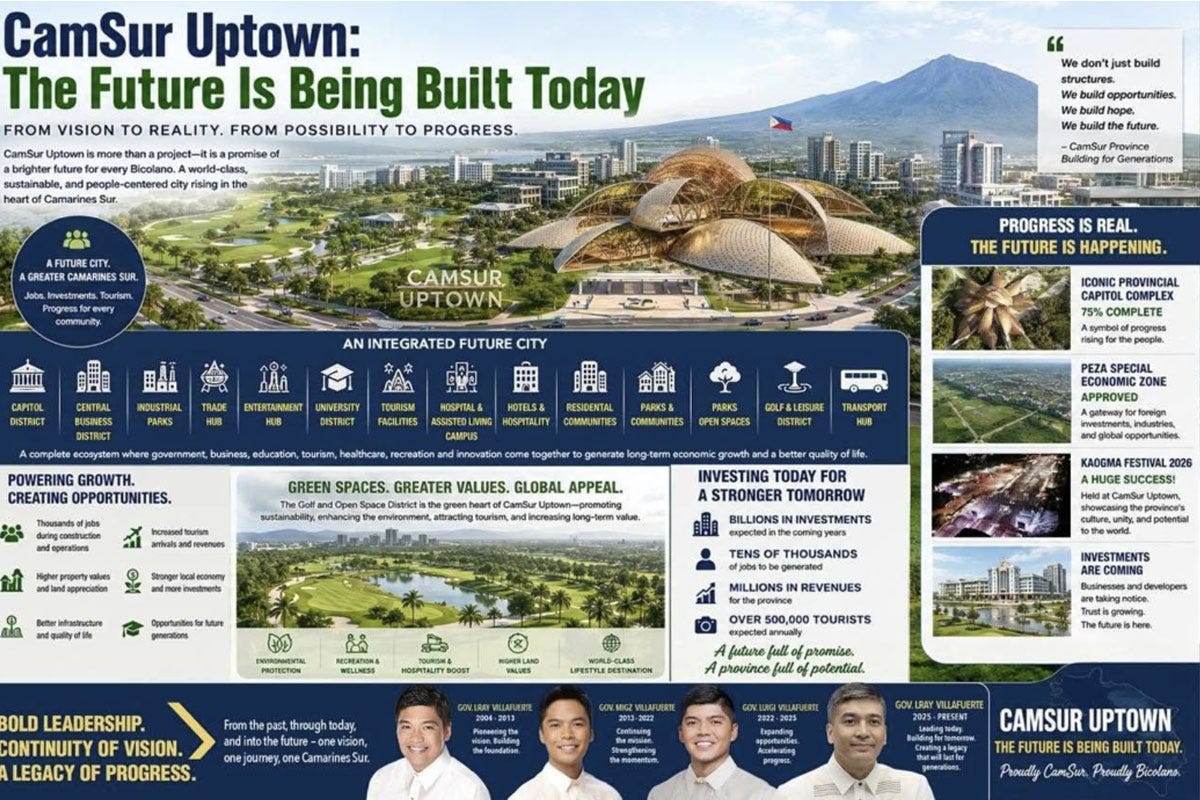
Camarines Sur is a province in the Bicol region of the Philippines, a few hours south of Manila. The provincial government is building a new 200-hectare district in Pili around a new capitol building, with plans for a digital campus, fintech offices, and back-office work. In June, the Philippine Economic Zone Authority (PEZA) cleared 6.7 hectares of that site as a special economic zone, letting companies set up there with national tax incentives without relocating to the capital.
The operator is the provincial government, instead of a national agency or a private developer. The new capitol building is already about 70 percent complete, and banks and BPO firms have expressed interest. Most Philippine economic zones are nationally chartered or run by private players. CamSur ran its zone through PEZA’s standard approval framework with a province in the operator role.
🛠️ Parallel Institutions

Healthy people lose 15 to 25 days a year to respiratory infections. In 2021, 12.8 billion infections occurred globally, over 65 million turned serious, roughly 1 million died, and combined costs reached about $600 billion. The gap has grown more urgent as AI enables both faster drug design and novel pathogen engineering, collapsing synthesis timelines from months to days.
On June 24, Intercept launched as a $500 million nonprofit to close it. The fund runs two lines: broad-spectrum preventatives (BSPs), drugs targeting the 200-plus viruses behind ordinary colds and flu, and air cleaning technologies (ACTs) for indoor spaces. Epidemiological modeling on the fund’s site shows that each approach alone demands unrealistically high adoption, while BSPs and ACTs combined bring the required uptake into achievable range.
The fund traces its lineage from Fast Grants through Arc to Frontier, philanthropic vehicles built for high-risk bets, backed by Stripe, Anthropic, the OpenAI Foundation, Gates, and Jane Street.

When an AI agent executes a contract on your behalf, who agreed to the terms? The Legal Context Protocol, launched June 24, 2026 as an Apache 2.0 open standard, works by having each service publish its legal terms, signed with a SHA-256 hash that an agent reads before transacting so both parties can prove exactly what was in effect at the moment of agreement.
Co-stewarded by the American Arbitration Association (AAA), one of the largest US commercial dispute-resolution bodies, alongside Integra Ledger, the protocol arrives as Gartner projects that 90% of global B2B purchases will flow through AI agents by 2028, representing over $15 trillion in intermediated spend.
No blockchain is required, and the well-known path mirrors the robots.txt pattern that crawlers already follow. LCP complements x402, the HTTP-native payment standard covered in Ipê News #39, adding jurisdiction and auditability so an agent can pay and prove what it agreed to in the same sequence.
When the Trump administration shuttered Climate.gov, the federal scientists behind it did not wait for a reversal. Climate.us went live on June 23, 2026, built by former Climate.gov staff following NOAA layoffs and operating as an independent nonprofit under Multiplier, a fiscal sponsor that allows the project to accept tax-deductible donations.
The site archives fifteen years of climate data, hosts the Fifth National Climate Assessment (a congressionally mandated report that researchers and policymakers rely on), and maintains the interactive tools and school materials from the original government domain.
The project has attracted roughly $250,000 from around 2,500 small donors and relies on more than 80 volunteer scientific reviewers, a distributed-expert model characteristic of parallel institutions that step into spaces left by retreating public agencies.
🌍 Other Interesting News
Conno Christou had a clean checkup in 2025. A swollen arm led to surgery prep and an 11cm tumor: aggressive lymphoma. Six months of chemo followed. When a final scan came back unclear, he fed the images into Claude. The model identified a known false positive. A fourth doctor confirmed it. He was clear.
The June 2026 public beta of SuperQode 0.2.0 treats the harness as the product: Superagentic AI‘s open-source framework sits above the LLM layer with local memory and multi-repo indexes, leaving the underlying model swappable.
Airplane Mode lets sessions run offline, and swapping the underlying model leaves the harness intact, though this is a first public beta and production readiness is not claimed. Source at github.com/SuperagenticAI/superqode.
🗓️ Events Radar
Hackathon Tech Floripa - Problem-first sprint; 19 gov/civic challenges across software, hardware, IoT, and AI; teams of 3-5 with weekly eliminations. Jun 27-Jul 25 - Florianópolis (in-person final Jul 25). Overlaps TDC Floripa Jul 22-24.
Workshop: AI Agents, Oracles, and the Future of Work - Free online; Solange Gueiros (Chainlink Labs DevRel) on multi-agent systems, smart contracts, Chainlink oracles, and DAOs. Jul 7 - 19:00–20:00 EDT.
💡 Join Ipê City Community
Follow the journey and join the community on Telegram.