


Hey builders! Welcome to the 50th edition of Ipê News.
🏘️ Community Updates
Sinking your feet into the sand and feeling the ocean breeze after a full day of building at Ipê Village. Do you remember that feeling?

Igor (”Iggy”) Noronha, CTO at Flow and buildathon champion at Ipê Village 2026 with Ipê Hub, leads the August Ipê Meetup. During the Village he ran two workshops: “Build and Orchestrate an AI Agent Team” using OpenClaw, and “Vibe Coding for Artists & Ghost Nation,” a session on the Northstar method for worldbuilding and autonomous creative pipelines.
On August 13 he covers the same terrain applied to daily work: setting up AI agents, choosing what to delegate, and what shifts in routine once they run. Its free. On August 13, 5-8 PM BRT, Florianópolis; exact location after registration.
🏫 Learning

Imagine ten contributors editing the same codebase at once: five human developers and five AI agents. How does anyone know whose change introduced a bug, or why a file looked different this morning? Version control solves this by recording every edit as a snapshot, with a log of who made it, when, and why. Git stores that log inside every local copy of the repository, so the history is fast and recoverable without a server connection.
Git’s core mechanic is the commit: a named snapshot of the project at a point in time. Contributors branch the history to work in parallel without stepping on each other, then merge those branches back once the work aligns. Git was built for the Linux kernel, which required tracking millions of lines of code across thousands of contributors. Scale and verified authorship were design goals from the start.
People often conflate Git with its hosting layer. GitHub and GitLab added pull requests, code review, and access controls on top of the Git tool, and their rise in the early 2010s brought professional adoption to 96% of developers surveyed. Those access controls, including who can push and who needs a reviewer, belong to the hosting service, while Git records the history.
🌐 Network Societies Update
After a year open for applications, Egypt’s Financial Regulatory Authority (FRA), which oversees non-banking financial markets, moved its fintech sandbox on August 8 from selection to live testing, clearing the first two projects to run under its watch without needing full market authorization. Each live-testing window runs three months, extendable by committee agreement.
The two projects test different edges of non-banking finance. GIG Egypt is running remote inspection and damage assessment for motor insurance, removing on-site claims visits. Lumin Soft, working with Azimut, lets foreign nationals tap their passport to a phone to verify their identity on the spot, opening insurance products, investment platforms, and other financial services to people who previously could not access them without local documentation.
FRA positions the sandbox as a shared space for innovators, startups, investors, research centers, and universities.

Novo Hamburgo is a mid-size city in Rio Grande do Sul, Brazil, about an hour north of Porto Alegre. On July 29, its city hall launched Programa Sandbox Novo Hamburgo: a formal testing window that gives companies temporary authorization, technical accompaniment, and regulatory cover to run innovative solutions inside the city. Applications are open through August 28, with up to ten proposals selected in this first round and the rest placed in a bank for future cycles.
The first cycle targets health tech, education, smart and sustainable cities, and Industry 4.0. Mayor Gustavo Finck named intelligent traffic control, weather and hydrological forecasting, and public safety as the priority problems the city wants tested on live infrastructure. The program is built as a controlled living lab: firms validate their products in the field before seeking certifications, and those that complete the sandbox rites earn a technical-capacity certificate, opening a path to provide services to the municipality itself.
🛠️ Parallel Institutions
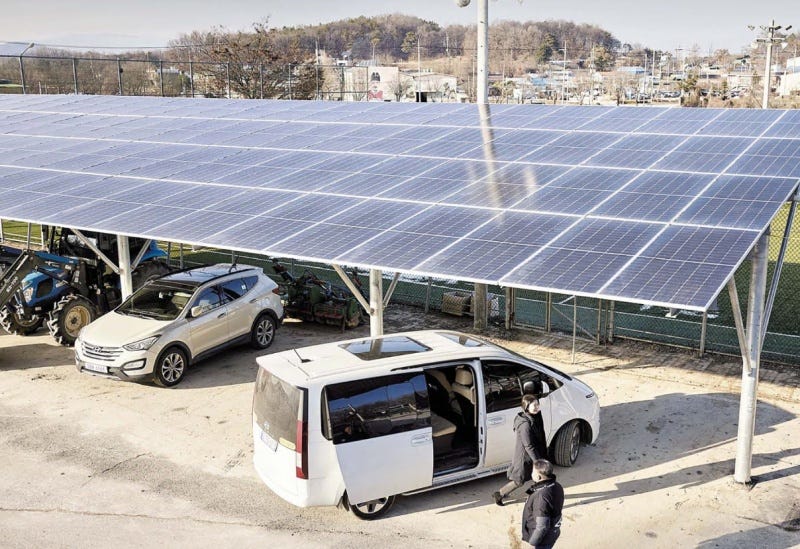
South Korea Picks First 86 Sunshine Income Villages for Resident Solar Cooperatives #ParallelInfrastructure
The standard solar program puts panels on utility land and routes the power into the grid. South Korea’s Sunshine Income Villages try a different arrangement. A village forms a cooperative, places panels on idle farmland or a local reservoir, and splits the power and revenue among residents. The country just selected the first 86 villages for the program, with the government covering up to 85% of installation costs.
Residents stay in the ownership chain from the start, so the income stays local rather than going to a utility or outside operator. The underlying logic works anywhere with idle land, a willingness to form a cooperative, and access to upfront financing.
A second application round drew several hundred more villages from cities and counties across the country within weeks. The Interior Ministry is aiming for thousands of designated villages by 2030.

For El Vecino‘s New Jersey customers, sending money home has meant cash, a store visit, and several days of waiting. El Vecino, RISE, and Movement announced the service on August 7. It starts in WhatsApp, settles via stablecoin rails in seconds, and requires neither a US bank account nor a new app.
Recipients in Mexico cash out through OXXO and Circle K locations or receive funds directly via SPEI. El Vecino has run US-to-Mexico transfers for 19 years, handling roughly $70 million a year, with 85% headed to Mexico. The corridor moved more than $62 billion in 2024, the largest in the world.
The service pilots with El Vecino’s roughly 20,000 users before expanding through the RISE network. WhatsApp works here because most of the population already use it, and the company is running on Movement’s regulated rails rather than building its own.
🌍 Other Interesting News
Poppy Guy, 29, noticed unusually dark skin in Malaga alongside symptoms her GP had put down to anxiety. She described them to ChatGPT, which flagged Addison’s disease. She went back to her GP; he sent an urgent referral. She collapsed in adrenal crisis days later. Doctors confirmed the diagnosis.
Swedish startup Jetson‘s single-seat eVTOL runs eight electric motors for roughly 20 minutes at a software-capped 102 km/h. It qualifies under FAA Part 103, so no pilot license in the U.S. Jetson’s site now lists $148,000 with 2028 delivery, up from the $128,000 in the viral post.
French foundry Atelier Missor is assembling a ~15 m bronze Prometheus at Starbase without a SpaceX commission. The Paris-area studio sees the fire-bringer as the right symbol beside humanity’s multiplanetary launch site. Their longer bet: titanium statues built to outlast civilizations.
🗓️ Events Radar
Blockchain.RIO 2026 - LATAM’s main institutional blockchain conference; tokenization, stablecoins, and digital financial infrastructure. Aug 12-13 - ExpoRio, Cidade Nova, Rio de Janeiro.
NextWave Hackathon 2026 - 24-hour AI and payments build across four simultaneous cities; payments, logistics, and AI-native tech tracks; $25k pool, 160 builders, OpenAI tooling. Aug 28-30 - São Paulo (+ Bogotá, CDMX, Buenos Aires); reg closes Aug 24.
WoHackathon Solana + SouJava - Women-focused Solana hackathon series across five Brazilian cities in H2 2026; online workshop day one, in-person build day two; host-approval entry. Aug 15 - Anhembi Morumbi, São Paulo. Hosted with SouJava.
💡 Join Ipê City Community
Follow the journey and join the community on Telegram.