

Hey builders.
OpenAI has released hundreds of AI-written mathematics papers, and researchers are working out what to make of them. We also caught up with builders at the Network State Conference, where Network School announced a funding round at a US$2 billion valuation. This edition follows drones carrying coffee, digital-dollar payments and gene therapies changing people’s lives.
Community Updates
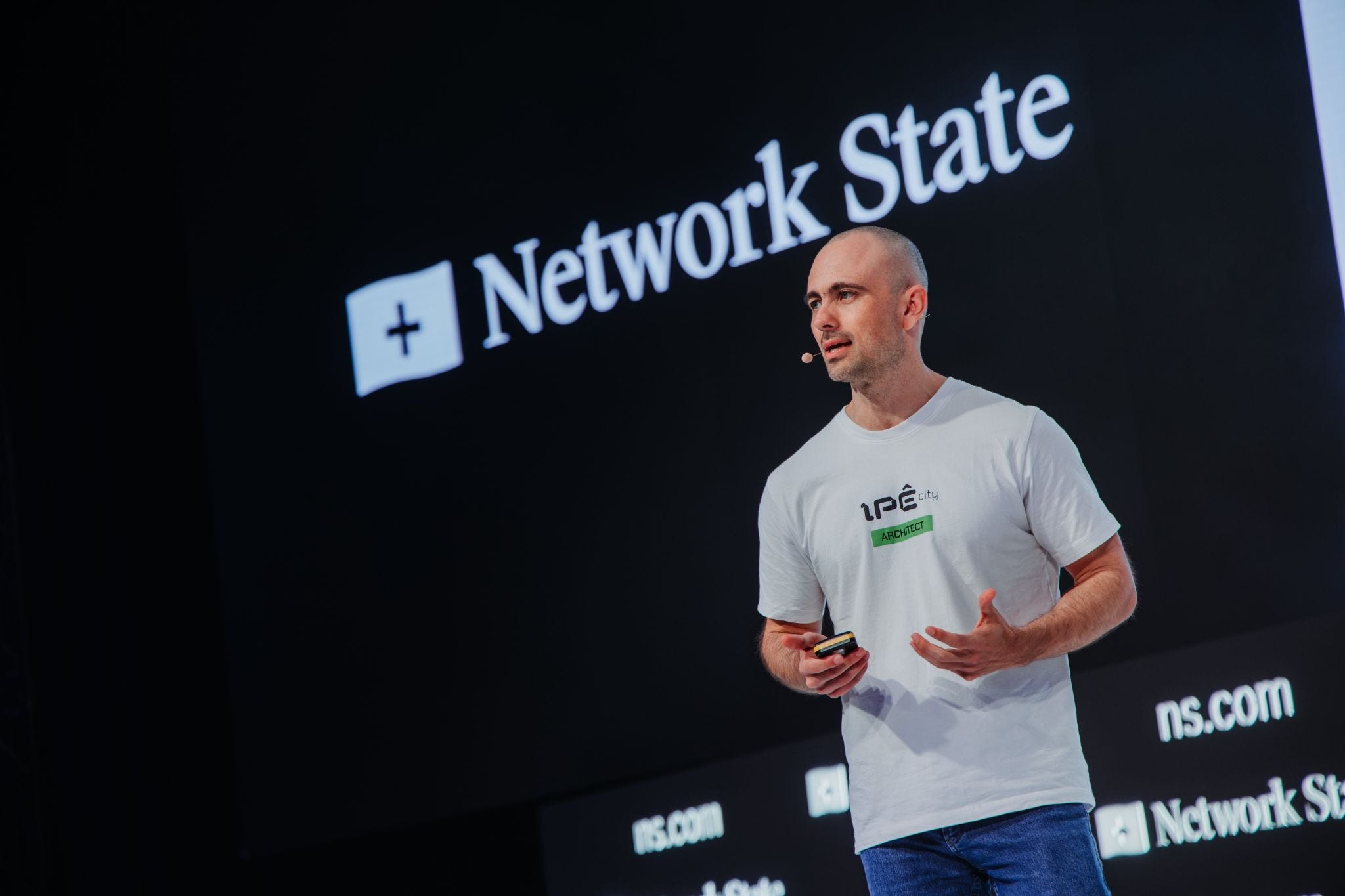
We were in Singapore on 9 October for the Network State Conference. One of the big announcements was a funding round for Network School at a US$2 billion valuation, led by Polychain. Vitalik Buterin, Ethereum’s cofounder, discussed how AI is helping with Ethereum research and coding. The Zcash sessions focused on making digital payments private, while Kazakhstan’s Alatau City team presented plans for a new city built around digital finance.
There was plenty to argue about, too. Balaji Srinivasan and Curtis Yarvin debated decentralised democracy versus government under one powerful leader. Historian Niall Ferguson discussed building new education institutions, and founders shared communities taking shape in Sri Lanka and Thailand. I presented Ipê City’s first permanent hub in Florianópolis, our focus on frontier technology, and why we need better ways to explain what these technologies can do. You can watch my five-minute talk or explore the full conference recordings on the Network State Podcast channel.
Learning
What is inference?
Inference is what happens when an AI model uses what it learned to produce an answer or a prediction. When you ask a chatbot to summarize an email, it processes your request and generates the summary. That’s inference.
Training is how the model learned its patterns in the first place. It works through examples and adjusts its internal settings. During ordinary inference, it uses those learned settings to respond to a new input.
You can ask the same trained model to shorten the email, translate it or turn it into a list of tasks. Each request gives it a new input to work with. A clearer prompt can improve the answer without retraining the model.
Using the model still takes computing power after training is finished. That work can happen on your own device or on a server. So when someone talks about ‘inference costs,’ they mean the cost of running the model to produce an answer.
Frontier Science
OpenAI releases hundreds of AI-written mathematics papers

OpenAI gave an unreleased AI model roughly 4,000 mathematics problems and published 722 papers from its work on 6 October. The papers propose results across algebra, geometry, computer science and other fields, including faster computer algorithms and answers to long-standing questions in geometry and number theory.
The papers and their source files are public, so mathematicians can go through the work themselves. About 42% of the main results are also expressed in Lean, a tool that checks mathematical reasoning step by step. That gives researchers another way to examine the proofs.
The collection has already needed corrections: OpenAI withdrew three papers after finding an error and repaired 14 others, leaving 719 papers. Mathematicians are asking how much of the work is new and whether the computer-checked proofs support the claims written in the papers. The model itself isn’t public, which also makes reproducing the work harder.
Vietnam’s mountain-drone pilot carries coffee in 50-kilogram loads
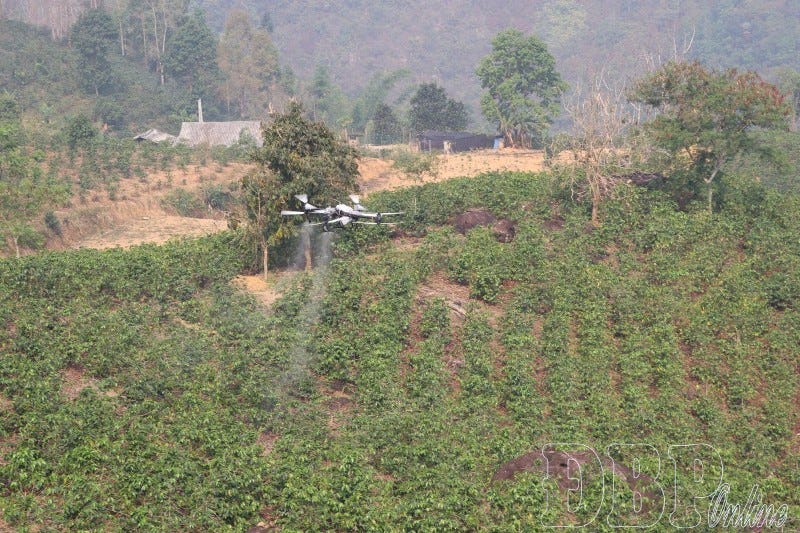
A drone trial in Mường Ảng, Điện Biên. Credit: Nhat Phuong / VnEconomy.
Getting harvested coffee off a steep mountain can be harder than transporting it the rest of the way to a buyer. In Mường Ảng, in Vietnam’s Điện Biên province, Vietnam Post is testing drones that carry coffee from farms to collection points. Trucks take over from there. Since the trials began in September, the drones have made 118 flights, each carrying 50 kilograms of coffee.
FPT supplies the drones and flight-control software, while Vietnam Post connects the flights to its delivery network. The controlled provincial pilot lets the team test how the mountain leg of a delivery can work by air. They hope to cut transport time or costs by 20–30%.
Frontier Societies
Network School announces a funding round at a US$2 billion valuation

An earlier partnership agreement between Network School and Kazakhstan. Source: Network School. This is not the October funding announcement.
At the Network State Conference, Polychain founder Olaf Carlson-Wee announced a funding round for Network School, Balaji Srinivasan’s community for people who want to live, learn and build together. Polychain is leading the round at a US$2 billion valuation, with a16z, Coinbase and Srinivasan also participating. The amount being invested wasn’t disclosed.
Network School brings housing, learning and remote work into the same community. Its current campus in Astana, Kazakhstan, offers housing, meals, shared workspaces, workshops and technology education. People can work on their own projects while learning and spending time with other builders.
Frontier Health
A teenager no longer needs monthly transfusions after gene editing

Vian, who hopes to become a nurse. Credit: BBC.
Vian, a 16-year-old from Coventry, grew up needing a blood transfusion every month. She has thalassaemia, an inherited condition that stops her body making enough healthy haemoglobin, the protein that carries oxygen in the blood.
Doctors collected her own blood-forming stem cells and edited them to make more of the version of haemoglobin normally produced before birth. After chemotherapy prepared her body, they put the edited cells back in December 2025.
She no longer needs monthly transfusions and says she has much more energy. Her doctor describes this as a ‘functional cure’: the inherited condition is still there, but she no longer depends on transfusions to live with it. Vian hopes to become a nurse.
Gene therapy and goggles give some blind people useful vision

A trial participant uses the special goggles to locate a notebook. Credit: Dr. Chloé Pagot / Streetlab, Paris.
Retinitis pigmentosa destroys the cells in the eye that normally detect light. Researchers are trying to give some of the surviving retinal cells a new job by adding genetic instructions that make them respond to light.
Special goggles turn the scene in front of the person into bright amber pulses those cells can detect. With training, the person learns to interpret the signals. The result is partial vision, rather than normal sight, reading or face recognition.
In a ten-person safety trial, six people gained a meaningful improvement in light sensitivity. Four of the eight who completed practical tests could find a doorway or follow a line while using the goggles. There was no comparison group. One person had a temporary blockage in a retinal artery, a serious eye event that resolved within minutes.
Frontier Security
A Dutch field test connects drone detection and interception on one screen

An engineer holds an interceptor during Nexus tests in Katwijk aan Zee on 30 September. Credit: Piroschka van de Wouw / Reuters.
A Dutch company called Intelic is building software that lets different drones, radars, sensors, and defense systems in Ukraine work together. Much of this equipment comes from different manufacturers and was never designed to communicate with each other.
Its platform, Nexus, works like a shared operating system for the battlefield. It combines data from different sensors, uses AI to help identify targets, and can coordinate interceptor drones. A human still gives the final approval before an attack.
AI is increasingly being used to coordinate entire networks of military systems, not just individual drones. That can make battlefield decisions much faster and makes it easier to plug new drones, sensors, and weapons into the same system.
Open-source maintainers can apply for free recurring AI security scans
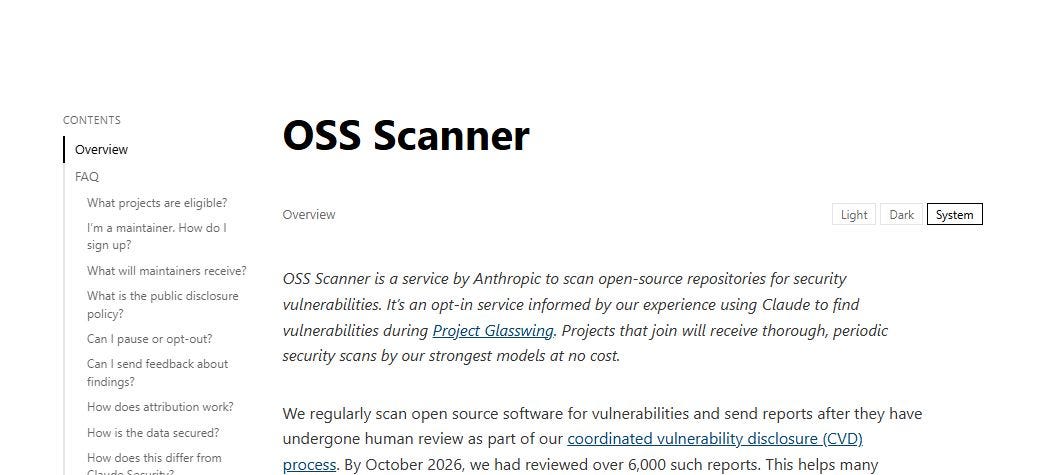
Official OSS Scanner overview. Screenshot: Anthropic.
A lot of the software that other services rely on is maintained by small open-source teams. Anthropic has opened OSS Scanner, a free AI service that regularly looks for possible security bugs in eligible projects. It tested the service with dozens of maintainers and is now accepting applications from people responsible for widely used software.
When it finds a suspected bug, the report explains how to reproduce it and, when available, suggests a fix. That gives the maintainer something concrete to try. The fast-track reports arrive without human review, so the maintainer checks whether the bug is real and the fix works. Anthropic decides which projects can use the service case by case.
Frontier Finance
Stripe puts OpenUSD inside business payment accounts
Official illustration accompanying Stripe’s Open USD rollout. Source: Stripe.
Businesses using Stripe can now hold Open USD, or OUSD, in their payment accounts. It’s a digital token designed to track the US dollar, created by Open Standard, a company founded by Coinbase, Mastercard, Shopify, Stripe and Visa.
They can hold OUSD in Stripe Treasury, spend it through stablecoin cards and send it to supported crypto wallets in more than 100 countries. That connects a business’s usual payment account to places where people use digital dollars.
Stripe says businesses can convert dollars into OUSD and back without minting or redemption fees. Open Standard still charges a transaction fee. The service launched on 30 September; which features a business can use depends on its account and country.
Worth reading
Mosquitoes are a choice
Maya Rosen explores ways to control disease-carrying mosquitoes, including releasing modified males whose female offspring cannot survive. She explains how the biology works and why getting a method into use can take years of regulatory decisions.
Events
DevDay Exchange Community Hackathon: São Paulo
23 October · São Paulo
A community hackathon to build AI applications with Codex and the OpenAI API. Host approval required; capacity 120. Fee not stated.
DevDay Exchange Community: Rio
24 October · Rio de Janeiro
Portuguese-language practical sessions and demonstrations of AI agents and Codex. Free; description requires host approval; capacity 150.
Lovable Meetup with Oracle — São Paulo
26 October · São Paulo
Bring a laptop to build a first product with Lovable and explore cloud infrastructure with Oracle. Free; host approval required.
Devin Meetup — São Paulo
28 October · São Paulo
A demonstration and discussion of Devin, the coding agent, with practical workflows and questions for the team. Host approval required; fee and deadline not stated. Laptop recommended.
AI Builder Tour — Florianópolis
30 October · Florianópolis
A full day of building AI agents, automations and web products, with demonstrations and practical sessions. Normal first lot R$249.99; VIP R$549.99.
Onchain Legal Summit :: Devcon India 2026
4 November · Mumbai, India
A gathering about onchain legal entities, AI-agent liability, arbitration and public records. Registration required for venue; public fee and admission conditions not listed. Agenda pending.
PlatformCon Live Day — São Paulo
7 November · Nubank Spark · São Paulo
A day for teams building the internal platforms that help developers ship and operate software. Early bird R$299 until 15 October at 18:59 BRT; general admission R$399.
Web Summit 2026
9–12 November · Lisbon, Portugal
A large gathering of technology founders, investors and product teams, including AI and robotics. General attendee pass displayed €995 (€809 before sales tax). Travel and accommodation additional.